
Last updated September 10, 2026
Full 25-point door and opener safety check with every visit - springs, cables, rollers, tracks, and your LiftMaster or Chamberlain opener included
You get a price before we start. It does not change when the truck arrives.
 Before
 After
After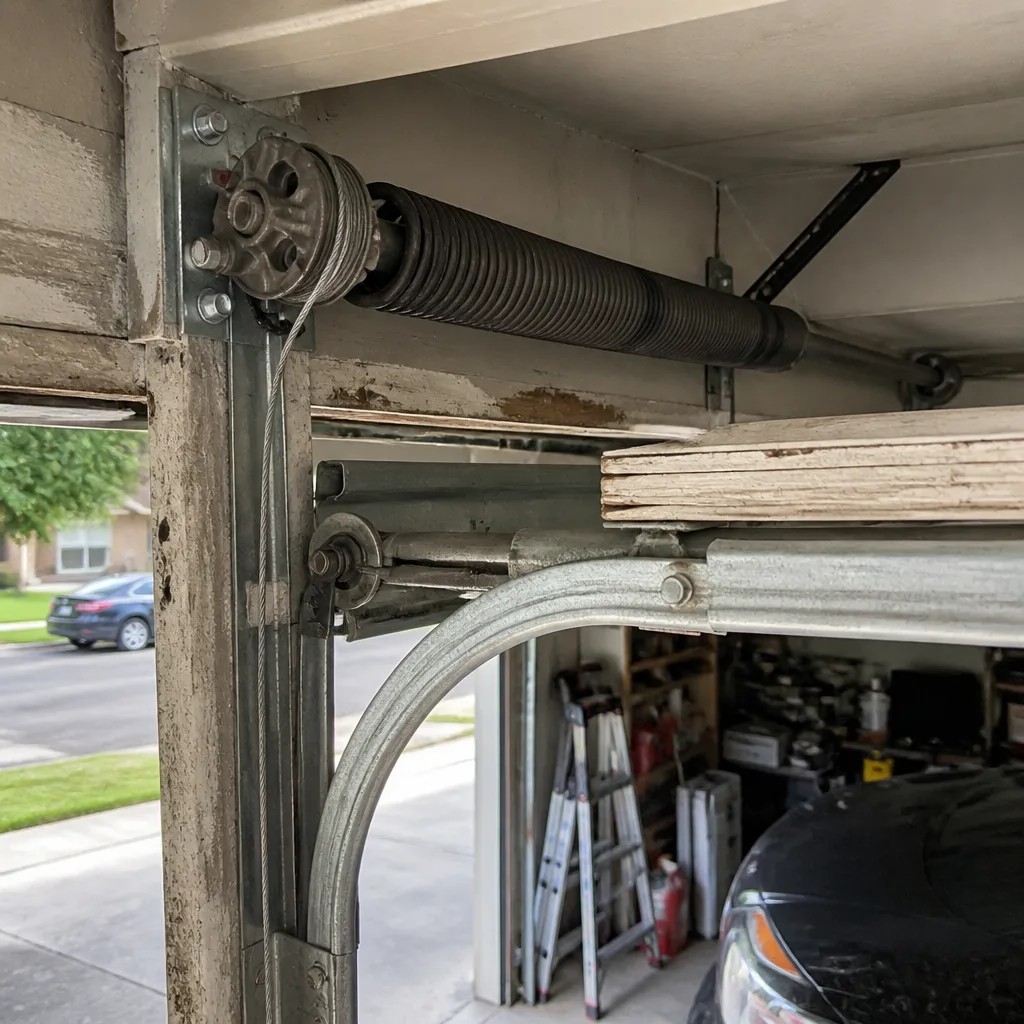 Before
 After
After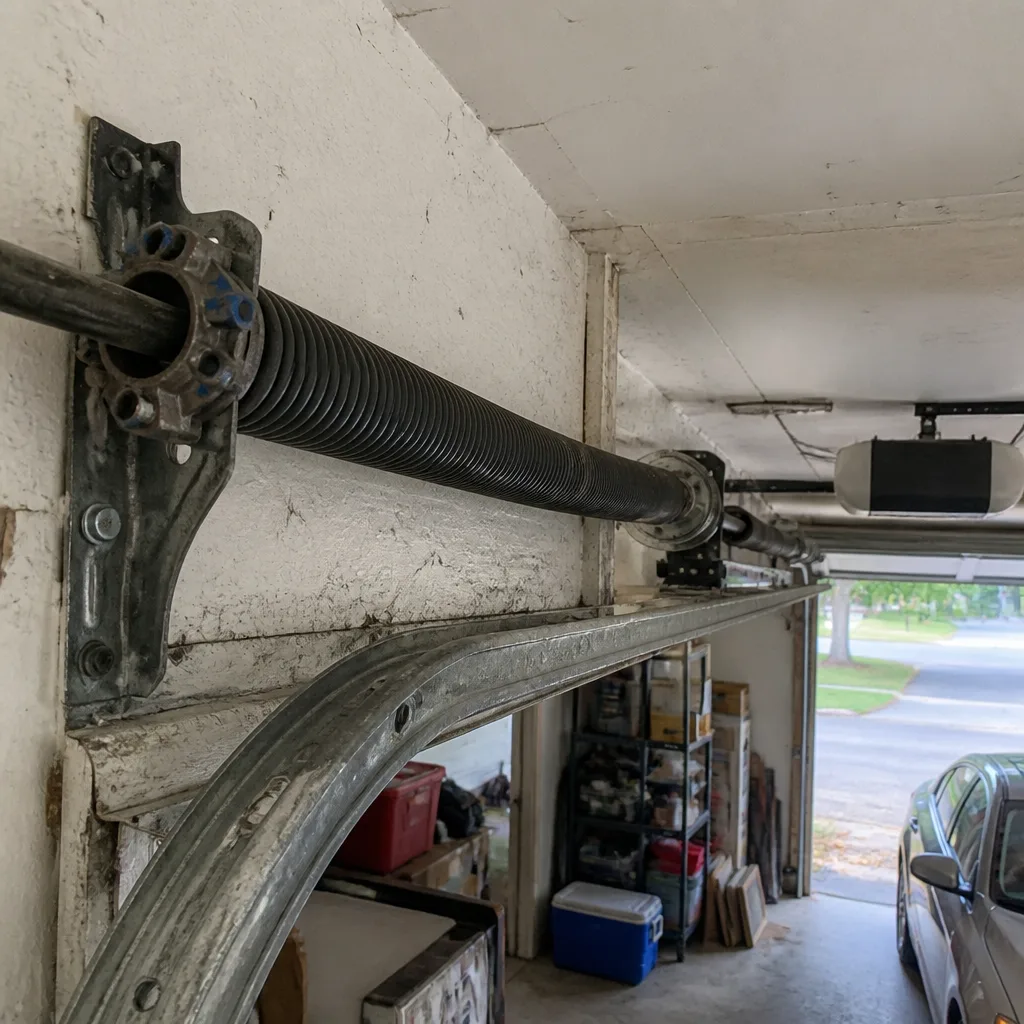 Before
 After
AfterThe Complete Guide to Garage Door in Plano
Your garage door is the largest moving part of your house and probably the one you know the least about. Most homeowners in Plano can’t name a single component inside that steel panel until one of them breaks at 7 a.m. on a workday and the car won’t come out. A typical door cycles up and down 1,500 times a year. That’s 1,500 chances for a spring to fatigue, a roller to seize, or a track to drift out of square. This guide maps the whole system so you know exactly what you own, what it needs, and what a repair should actually cost in Plano before you pick up the phone.
Quick Answer
Garage door problems in Plano almost always trace back to four components: springs, cables, rollers, or the opener. Spring failure is the most common and the most dangerous, typically running $180 to $340 for a pair in this market. Most repairs are same-day jobs, but the smartest money is a full-system inspection every two years so a $30 roller doesn’t become a $900 track replacement. See our Garage Door Cost Breakdown: The Plano Homeowner’s Reference for 2026 for typical repair ranges.
Table of Contents
- How Your Garage Door System Actually Works
- Why Plano Clay Soil Changes Everything
- Torsion vs. Extension Springs: What You Really Have
- The Insulation R-Value Question, North Texas Edition
- How to Read Your Opener and Door Nameplate
- What a Real Inspection Looks Like
- Common Mistakes to Avoid
- When to Call a Professional
- Frequently Asked Questions
How Your Garage Door System Actually Works
Still, most doors in Plano neighborhoods like Forest Creek or Whiffletree follow the same anatomy. You’ve got the door panels themselves, which ride on steel tracks anchored to the ceiling and the wall on each side. You’ve got rollers mounted on hinges that carry the panel weight through those tracks. Above the closed door sits the spring assembly. Most Plano homes built after the early 1990s use a torsion system: one or two tightly wound springs mounted on a steel rod across the top of the door opening. Under the door’s weight, those springs store tension like a wound clock, and that stored force does nearly all the lifting. The opener, if you have one, is just a motor that nudges the door along the track, it’s not doing the heavy work. If the opener is straining, the problem is almost never the opener.
Here’s the counterintuitive part. A properly balanced garage door weighs about 8 to 10 pounds at your hand. That’s it. You should be able to lift a 200-pound door with one arm if the springs are doing their job. When a spring breaks, that illusion collapses instantly. The door becomes dead weight. If the opener tries to lift it anyway, you’ll hear grinding, see the rail flex, and eventually burn out the motor or strip the gear. That’s how a $200 spring turns into a $450 opener replacement. Knowing the anatomy lets you catch the cheap fix before it eats the expensive one.
The Five Components That Fail in Order
- Springs. They have a rated cycle life, usually 10,000 cycles for a standard spring. That’s roughly seven to nine years in a household that opens the door four times a day. When a spring snaps, you’ll hear it. It sounds like a gunshot from inside the garage.
- Cables. These steel cables run alongside the door and carry the tension from the springs. They fray before they break. If you see loose strands near the bottom roller bracket, call before the cable lets go at full tension.
- Rollers. Nylon rollers with ball bearings wear down silently. Cheap builder-grade rollers last three to five years. When the door starts to sound gravelly or shudders on the way up, the rollers are telling you something.
- Hinges and brackets. These are stamped metal and can crack at the stress points. A cracked hinge is a fast, cheap fix. Ignored, it can twist the panel and pull the door out of alignment.
- The opener motor and logic board. Motors rarely fail first. Usually the gear inside strips or the logic board burns out after years of surge exposure. North Texas thunderstorms and the power flickers that come with them shorten opener board life.
Why Plano Clay Soil Changes Everything
Here’s what national guides miss and what any Plano garage door repairman sees in his sleep. Collin County sits on a crust of expansive clay soil. In the wet spring and fall, that clay swells with moisture. In August, it bakes hard and shrinks. Your foundation sits on that moving ground. It shifts, settles, and heaves.
The garage door, however, is bolted to the opening in that foundation. When the slab tilts half a degree over five years, the door opening goes out of square. The tracks, which were installed level and plumb, now run slightly out of true. You’ll notice it first as a door that rubs on one side, then a gap at the bottom corner, then a roller that pops off the track. We’ve seen doors in west Plano near Willow Bend and over in Custer Hill that were perfectly installed in 2010 and are now dragging on the jamb by three-quarters of an inch. The door didn’t change. The ground under it did.
This isn’t a reason to panic. It’s a reason to have your track alignment checked as part of any service call, not just when something breaks. An experienced tech can shim the track or adjust the door balance to compensate for foundation creep. It’s a normal, recurring maintenance item in Plano, like brake pads on a car. But a company that only wants to sell a new door will see the misalignment and call it a catastrophic failure. The honest answer is simpler: the clay moved, let’s square the track back up.
If you’re wondering whether your door is straight, do this quick check. Close the door and look at the gap between the door and the frame on both sides. If one side is tight and the other has a finger-width gap, the opening has moved. If the door binds only when the temperature has shifted dramatically, the slab is breathing. That’s clay soil. It’s not your imagination, and it’s not a cheap door panel that warped. It’s the ground under Plano doing what it has always done.
Torsion vs. Extension Springs: What You Really Have
This matters for what a repair costs and whether you should ever touch it yourself. When we quote a spring job over the phone, the first question we ask is which system hangs above your door.
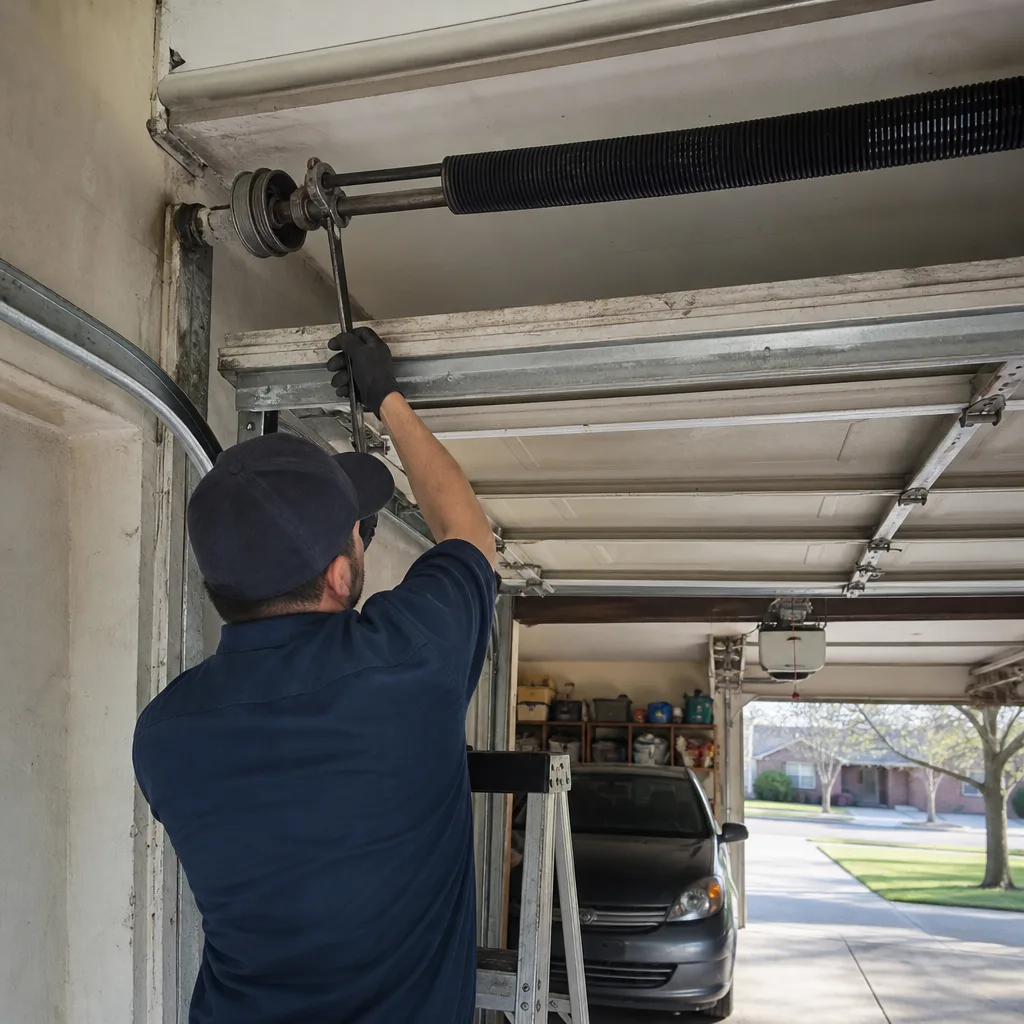
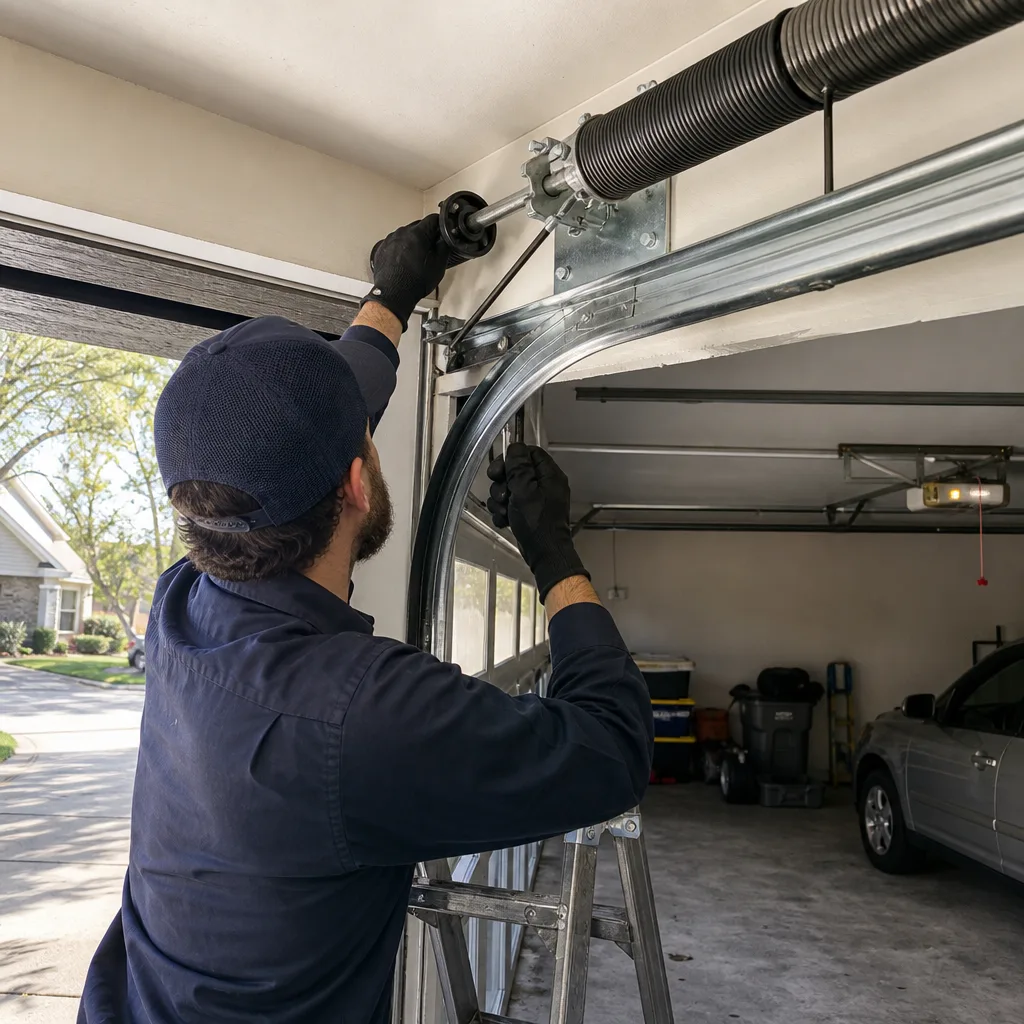
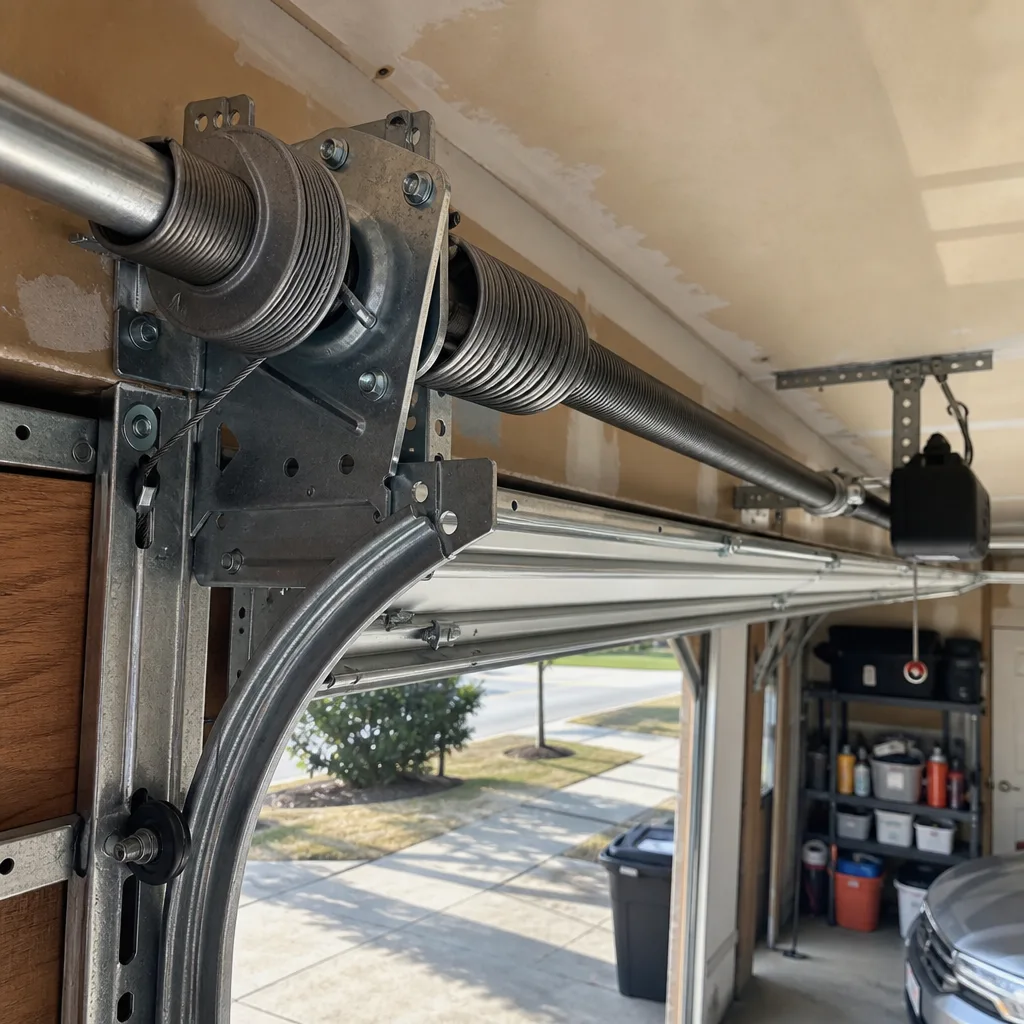
Torsion springs are the modern standard. They sit horizontally on a metal rod above the door, parallel to it. You’ll see one or two of them depending on the door’s width. They work by twisting: when the door closes, the spring winds tighter. Torsion springs hold their energy under a clamp, and when one fails, the two halves of the coil spin opposite directions with enormous force. Most homes in Plano built after about 1995 have torsion systems. A pair of name-brand torsion springs, installed and balanced, runs roughly $220 to $340 in this market, depending on door weight and cycle rating.
Extension springs hang along the horizontal tracks on both sides of the door, perpendicular to it. They stretch when the door closes and contract to lift it. You’ll still find extension systems on many older east Plano homes from the 1970s and 1980s. Replacement is usually a bit cheaper, often under $200, but they fail a bit faster and don’t lift as smoothly. The important thing is that extension systems, by code, must have a safety cable running through the center of each spring from the back track to the front. If the spring snaps without a safety cable, it becomes a steel projectile aimed at whatever is in its path.
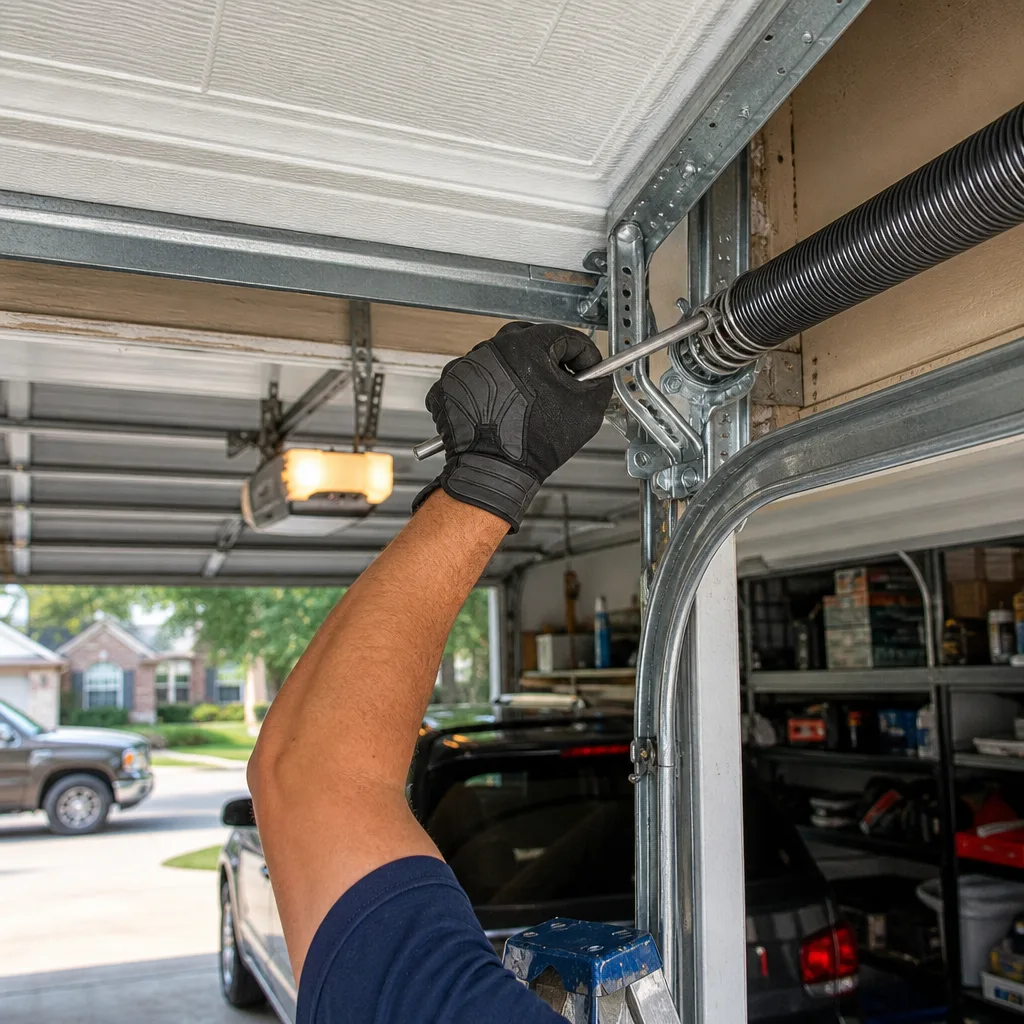
Don’t take a spring repair as a fun weekend project. A door is 200 pounds riding on two springs. Respect it. Winding a torsion spring requires specialty rods and a specific technique, and a slip can break a wrist or worse. Even extension springs hold enough force to hurt you badly if you unhook one wrong. If you want to know which system you have, look above the closed door. Horizontal coiled spring on a rod? Torsion. Two long springs stretched along the track? Extension. Then call someone who knows how to balance it properly. We sell and install parts for both systems and we’ll tell you honestly which one your door uses.
The Insulation R-Value Question, North Texas Edition
Your garage door is a giant exterior wall that faces the afternoon sun. In July, a west-facing garage door in Plano can reach 140 degrees on the inside surface. If your garage shares a wall with your laundry room, your guest room, or your kitchen, that heat doesn’t stay in the garage. It bleeds into the house and makes your air conditioner run longer.
This is where R-value comes in. It’s a measure of thermal resistance; higher numbers mean better insulation. A standard non-insulated steel door is about R-3, which barely slows the heat. A double-layer door with a foam core might hit R-9. A premium tri-layer door with a thick polyurethane core can reach R-16 or higher. The practical difference on a hot Plano afternoon is huge: an R-16 door might keep the garage 15 to 20 degrees cooler than an R-3 door, which translates to less heat soaking into your house and a smaller electric bill from June through September.
You don’t need to build a meat locker. For an attached garage in Plano, an R-8 to R-12 door is the reasonable middle ground for most homes. If your garage is fully finished, air-conditioned, or doubles as a workshop, step up to R-14 or R-16. The cost difference between an R-9 and an R-16 door on the same model is often only a few hundred dollars, and that’s paid back over a few North Texas summers. You can also add insulation retroactively to some existing doors, though the simplest approach is to choose it when the door is replaced.
One more local consideration: the wind. Spring storms and the occasional tornado season pressure differential can bow a flimsy door. Better doors with a layered construction resist wind better and stay square longer. In Plano, the door has two jobs: keep the heat out and keep itself on the track. Insulation does both.
How to Read Your Opener and Door Nameplate
Before you call anyone for a repair, spend ninety seconds finding out what you actually have. It changes the quote and it stops you from being overcharged for a generic mark-up on parts you don’t need.
On the opener: Look at the top of the motor housing, usually the side facing the ceiling. There’s a metal or plastic nameplate riveted to it. It lists the brand, the model number, and often the date of manufacture. Brands like LiftMaster, Chamberlain, Genie, and Craftsman all stamp their model numbers clearly. A garage door opener installed in 2008 is on year sixteen of a part with a lifespan of about twelve to fifteen years. If you know the model and the year before you call, the quote you get is specific instead of vague. Write down the brand and model, even if it’s just a note in your phone.
On the door itself: The door panel has a label, usually on the inside edge of a side panel or along the bottom edge near the bottom bracket. It lists the manufacturer, often a brand like Clopay, Amarr, or Wayne Dalton, plus the model line and sometimes the door’s size and construction. That label tells you if the door is insulated or not, wind-rated, and what size springs it was supposed to have installed.
Why does this matter? Because garage door springs are rated to a specific door weight, not just a general size. The wrong spring means a door that won’t balance, an opener that grinds itself to death, and a repair that fails inside a year. If you can read off the door label and the opener label to whoever answers the phone at the garage door company, the quote you get is real. And if the person on the line doesn’t ask for that information, call someone else. The company that quotes blind is the company that surprises you at the driveway.
What a Real Inspection Looks Like
There are two kinds of garage door inspections in the world. One is a five-minute drive-by where a salesperson in a van tells you your door is unsafe and hands you a brochure for a $2,000 replacement. The other is an actual inspection. Here’s what the real one includes, item by item.
- Spring cycle assessment. A good tech checks spring wire size, coil length, and the age of the spring. We count spring cycles the way you count tire miles, we’ll tell you what’s left on yours. If you’ve got 2,000 cycles left, you know a spring job is coming but not urgent. If you’ve got 200 cycles left, you know it’s a one-year window.
- Balance testing. The door is pulled to half height and released. If it holds, the springs are doing their job. If it drifts up or drops, the balance is off and something is wearing out. This test takes thirty seconds and tells you more than any amount of staring at the door.
- Track and bracket inspection. Every bolt and lag screw is checked at the track brackets, the spring anchor, and the opener rail. On Plano homes, we specifically look for track twisting caused by foundation movement.
- Roller and hinge wear. Rollers are pulled from the track and checked for flat spots, cracked nylon, and seized bearings. Hinges are examined for stress cracks. A six-dollar roller gets replaced on the spot. A cracked hinge is flagged and replaced for parts cost.
- Cable and drum condition. The lift cables are inspected for fraying and the drums for proper winding. If a cable has any unraveled strands near the bottom bracket, it’s replaced wire for wire.
- Safety system test. The photo-eye sensors at the bottom of the door opening are tested for proper alignment and function, and the opener’s auto-reverse force is tested. The auto-reverse is the part that stops the door from crushing a child or a pet. It’s non-negotiable.
- Lubrication and tightening. Every moving point gets lubricated with a proper garage-door lubricant, not WD-40, and every fastener gets torqued. A dry hinge wears faster in Plano dust. A loose lag screw works its way out over time.
That’s a real inspection. It takes about forty-five minutes at a normal Plano house. If someone hands you a quote for a new door after looking at it for ninety seconds, they didn’t inspect anything. They sold. There’s a difference.
Common Mistakes to Avoid
- Ignoring a noisy door. A grinding sound is the sound of metal wearing on metal, and it gets more expensive the longer you ignore it. In Plano, dust from dry weather accelerates that wear.
- Replacing the opener to fix a spring problem. If the door is heavy to lift and the opener labors, the springs are the issue. A new opener on a broken spring will strain the same way the old one did, and you’ll be buying a second opener in two years.
- DIY-ing spring work. Torsion and extension springs store enough energy to break bones. This is not a money-saving project. It’s a hospital visit waiting to happen. A real expert always flags the danger, and here it is: don’t touch springs without proper winding tools and training.
- Letting tracks go out of square. In Plano, clay soil will push your door out of alignment even if nothing else fails. Annual track alignment checks catch the drift before a roller pops and the door jams open.
- Buying the cheapest door possible. A no-insulation, thin steel door bakes in the Plano summer sun and flexes in spring storms. You’ll pay for the cheap door twice: once in the purchase, again in the electric bill and the early replacement.
- Calling a company that quotes blind. If they don’t ask what brand of spring you have, what year the opener is, and whether the door is insulated, they’re reading from a script. You want the person who asks questions, then quotes a number that does not change at the driveway.
When to Call a Professional
Call a professional when the spring breaks, because it will, and because wiring a new one involves stored energy that hurts people every year. Call when the door comes out of the track, when a cable frays, or when the opener reverses without reason. Call when you’ve done the basic lubrication and the door still groans and shudders. If you live in an older Plano home and the door has never been re-balanced, call for an inspection before it fails. Otto’s Garage Door offers free estimates in Plano, call (945) 215-6820 and you’ll talk to a person, not a queue. We’ve been repairing doors in this county since 2004, and the name on the van is the same name on the invoice and the name on the license.
Frequently Asked Questions
Most garage door repairs in Plano run between $120 and $350 depending on what failed. A broken spring pair typically costs $180 to $340 installed, a roller replacement runs $120 to $220, and opener repairs start around $140. The exact number depends on your door’s weight, brand, and spring type. Call (945) 215-6820 for a free estimate on your specific door, and the price we quote on the phone is the price we hold at the driveway.
Yes, most Plano garage door repairs we perform same day or next day depending on parts availability. Spring replacements, roller jobs, and track adjustments are common enough that the parts ride on the truck. When we quote a job over the phone, we tell you what’s on the van and what isn’t.
Every two years for a standard residential door in Plano, and every year if the door faces west into afternoon sun or shows signs of track drift from clay soil movement. The inspection catches a $30 roller before it becomes a $900 track replacement, and it gives you a read on how many cycles your springs have left.
That’s the clay soil under your foundation. Spring rains swell the ground, the slab shifts slightly, and the door opening goes out of square. August heat bakes the clay back down and the door shifts again. It’s normal for Plano, and a track alignment during a service call fixes it until the soil does its next thing.
The brand matters less than the installation and the balance of your door. Chamberlain and LiftMaster are both solid choices that we service and install regularly, and a belt-drive model will be quieter. But a good opener on a poorly balanced door will still burn out early. We check the door balance before any opener goes on.
No. The number we quote on the phone is the number on the invoice, and it’s written before any work starts. That’s our promise, backed by the 90-Day Done Right Promise in writing on every job. You’ll see the price before we touch a tool, and one call to the owner brings us back if anything isn’t right.
The Bottom Line
Your garage door is a system, not a single object. It has springs that wear out on a schedule, tracks that shift with Plano’s clay soil, and insulation that quietly determines your summer electric bill. The difference between a $150 fix and a $1,400 emergency is knowing what you own and what it’s trying to tell you: a gravelly sound means rollers are going, a heavy door means springs are weakening, a crooked gap means the ground is moving. Read your nameplates. Get a real inspection. Fix the small thing before it breaks the big thing. For more guides & resources, explore our blog, or start with a free estimate from a Plano shop that’s been here since 2004, and whose owner answers the phone. We’d rather keep you as a customer for twenty years than win one big ticket.
Written by Otto Reinhardt, Owner at Otto’s Garage Door, serving Plano since 2004.